Bakery & Confectionery
Refined hazelnut oil can be evaluated in biscuits, cakes, pastries, confectionery fillings and selected coating systems. Formulation trials should consider texture, fat compatibility, oxidation and shelf life.

Explore food manufacturing, bakery, confectionery, cosmetic formulation, personal care, manufacturing systems and research applications of refined hazelnut oil.
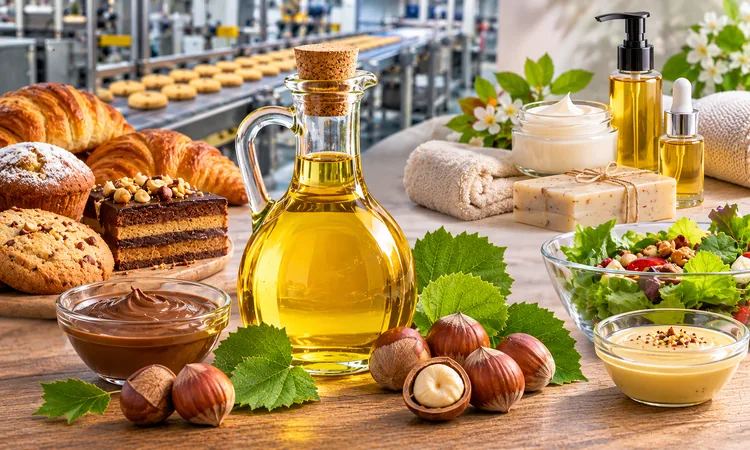
Refined hazelnut oil is a vegetable oil with a high oleic acid content and a defined physical and chemical profile. These characteristics make it relevant to ingredient selection across several manufacturing industries.
Food manufacturers may evaluate the oil for bakery formulations, confectionery fillings, sauces, dressings, snacks and other suitable prepared foods.
Cosmetic formulators may investigate refined hazelnut oil as an emollient or oil-phase ingredient in creams, lotions, balms, cleansing products and personal care formulations.
Industrial processors may also need technical guidance on storage, pumping, blending, ingredient dosing, packaging compatibility and oxidation control.
This resource contains 70 individual articles organized into seven categories. The articles discuss established uses, possible formulation approaches and research considerations.
The presence of an application in this library does not automatically establish suitability for a particular finished product or regulatory market.
Review Technical Specifications →Our application library covers seven areas of manufacturing, product development and technical research.
Refined hazelnut oil can be evaluated in biscuits, cakes, pastries, confectionery fillings and selected coating systems. Formulation trials should consider texture, fat compatibility, oxidation and shelf life.
Liquid vegetable oil can form part of sauces, dressings, emulsions and prepared foods. Manufacturers should evaluate viscosity, flavor, phase stability and preservation requirements.
Potential applications include cereal products, snack coatings, dessert sauces, spreads and selected frozen products. Processing and texture behavior require product-specific testing.
Refined hazelnut oil may be evaluated as an emollient or component of the oil phase in cosmetic formulations. Stability, purity, safety and regulatory suitability must be established.
Formulators may consider the oil for conditioners, hair oils, balms, soaps and grooming products. Compatibility with surfactants, emulsifiers and other ingredients should be tested.
Technical topics include bulk transfer, pumping, storage, metering, blending, filtration and packaging. Equipment and procedures must be suitable for the required product grade.
Research teams may investigate refined hazelnut oil in experimental formulations. Pharmaceutical or regulated applications require separate qualification and approval.
The fatty-acid composition and physical properties of refined hazelnut oil affect raw material selection and formulation development.
| Technical parameter | Specified value | Manufacturing relevance |
|---|---|---|
| Composition | 100% refined hazelnut oil | Product identity and declared ingredient composition. |
| Oleic acid | 74.2–86.7% | Principal monounsaturated fatty acid. |
| Linoleic acid | 5.2–18.7% | Polyunsaturated fatty-acid component. |
| Free fatty acids | Maximum 0.3% | Relevant to refining quality and oil condition. |
| Moisture | Maximum 0.2% | Relevant to handling and hydrolytic deterioration. |
| Peroxide value | Maximum 10 meq/kg | Indicator of primary oxidation products. |
| Density at 20°C | 0.898–0.915 | Physical identification and mass-volume considerations. |
| Iodine value | 81–92 | Indicates the degree of fatty-acid unsaturation. |
| Saponification value | 188–198 mg KOH/g oil | Relevant to fatty-acid characteristics and soap formulation calculations. |
| Refractive index at 20°C | 1.468–1.473 | Physical identity parameter. |
Oleic acid is the dominant fatty acid in refined hazelnut oil. Its concentration is relevant when comparing vegetable oil ingredients for formulation, nutritional composition and certain processing properties.
The fatty-acid profile can influence oxidative behavior, but actual stability depends on additional factors such as oxygen exposure, processing temperature, light, packaging and storage duration.
Oils containing unsaturated fatty acids may undergo oxidation during storage and processing. This can lead to changes in odor, taste and product performance.
Manufacturers should establish appropriate processing conditions, packaging and finished-product shelf-life studies. Peroxide value is one useful measure of primary oxidation, but it is not a complete measure of every stage of oil deterioration.
Liquid oil behavior is important in pumping, dosing, emulsification, mixing and coating operations.
Actual flow characteristics depend on temperature, equipment, formulation and process conditions. Buyers requiring detailed viscosity information should request suitable technical data or perform process trials.
The suitability of refined hazelnut oil depends on the intended product, processing method, required performance and regulatory environment.
Food manufacturers should evaluate the oil's sensory properties, fatty-acid composition, oxidation behavior and compatibility with other ingredients.
Bakery and confectionery applications may require particular fat functionality for texture, aeration, crystallization and product stability.
Replacing an existing oil or fat may require adjustment of the formulation and processing conditions.
Cosmetic developers may evaluate refined hazelnut oil as an emollient or component of the lipid phase.
Relevant considerations include skin feel, stability, compatibility, oxidation control, emulsification and final-product safety.
Suitable ingredient grade and regulatory documentation must be confirmed before commercial use.
Industrial systems may need to accommodate bulk drums, flexitanks or tanker deliveries.
Equipment selection should consider material compatibility, cleanliness, transfer flow, filtration, dosing accuracy and storage conditions.
Food manufacturing operations should use appropriate food-contact materials and hygiene procedures.
Experimental formulations should begin with suitable ingredient identification and a defined research objective.
Researchers may need additional purity, stability, analytical and compatibility data.
Regulated product categories require appropriate qualification and regulatory approval before commercial use.
Browse seven categories and open individual articles covering food manufacturing, cosmetics, personal care, process engineering and research applications.
Use the category filters to narrow the library to a specific industry. Each article includes technical considerations for its application. The information is intended for evaluation, not as a substitute for production testing.
Showing 70 of 70 articles
Explore the use of refined hazelnut oil as a liquid fat component in selected biscuit and cookie formulations, including texture and processing considerations.
Read article → Bakery & ConfectioneryLearn how refined hazelnut oil may influence batter formulation, crumb structure and finished-product stability in industrial cake production.
Read article → Bakery & ConfectioneryReview possible uses in muffin batters, where liquid fat contributes to mixing behavior, crumb characteristics and product development.
Read article → Bakery & ConfectioneryInvestigate viscosity, spreading characteristics and fat-phase compatibility in selected industrial pastry filling systems.
Read article → Bakery & ConfectioneryExamine the technical challenges of adding liquid oil to chocolate-related coatings, including crystallization and fat compatibility.
Read article → Bakery & ConfectioneryLearn how refined hazelnut oil may be evaluated for texture, flow behavior and ingredient distribution in nut-based fillings.
Read article → Bakery & ConfectioneryReview fat balance, cream spreadability, processing conditions and moisture management in wafer filling formulations.
Read article → Bakery & ConfectioneryConsider refined hazelnut oil in appropriate dough formulations or controlled frying trials, with attention to processing temperature and oxidation.
Read article → Bakery & ConfectioneryExplore how liquid oil affects dough behavior and finished texture in products traditionally dependent on structured fats.
Read article → Bakery & ConfectioneryAssess refined hazelnut oil for selected surface coatings and glazes where oil application, appearance and stability are important.
Read article → Prepared Foods & SaucesExplore the role of refined hazelnut oil in the lipid phase of dressings and vinaigrettes, including flavor and phase stability.
Read article → Prepared Foods & SaucesReview oil-in-water emulsion systems and the technical factors affecting droplet formation, texture and storage stability.
Read article → Prepared Foods & SaucesEvaluate refined hazelnut oil as an ingredient in selected sauces where sensory compatibility and formulation stability matter.
Read article → Prepared Foods & SaucesExplore oil-phase selection, ingredient suspension, oxidation and shelf-life considerations in herb-based sauce formulations.
Read article → Prepared Foods & SaucesLearn about the use of refined hazelnut oil in vegetable preparations, marinades and suitable ready-to-eat food applications.
Read article → Prepared Foods & SaucesReview oil ingredient selection, portioning, packaging and preservation considerations in prepared meal manufacturing.
Read article → Prepared Foods & SaucesConsider refined hazelnut oil as a clearly declared ingredient in purpose-developed culinary oil blends for foodservice.
Read article → Prepared Foods & SaucesExplore lipid-phase formulation, emulsification and mouthfeel in plant-based sauces and savory prepared foods.
Read article → Prepared Foods & SaucesLearn how liquid oils may affect spreadability, phase separation and texture in savory dips and paste-based systems.
Read article → Prepared Foods & SaucesEvaluate refined hazelnut oil for manufacturers developing finishing-oil products for professional culinary applications.
Read article → Snacks & DessertsExplore oil distribution, cluster formation, texture and baking performance in industrial granola manufacturing.
Read article → Snacks & DessertsReview fat-phase formulation, binding, oil migration and stability in cereal and protein bar development.
Read article → Snacks & DessertsConsider refined hazelnut oil for modifying viscosity, pumpability and texture in nut and seed spreads.
Read article → Snacks & DessertsExplore the challenges of incorporating liquid vegetable oil into frozen dessert fat systems and emulsions.
Read article → Snacks & DessertsReview oil selection, flow behavior, texture and formulation compatibility in chocolate dessert sauces.
Read article → Snacks & DessertsEvaluate oil-assisted coating adhesion and ingredient distribution in selected nut and seed snack products.
Read article → Snacks & DessertsExplore how edible oil may be used as a carrier for seasonings and coatings in selected snack processing lines.
Read article → Snacks & DessertsLearn about fat selection, dough handling, baking performance and crisp texture in industrial cracker production.
Read article → Snacks & DessertsExamine emulsion behavior, mouthfeel and stability in dessert cream systems containing vegetable oil.
Read article → Snacks & DessertsReview the design of suitable bakery ingredient systems containing a liquid oil component.
Read article → Cosmetics & Skin CareExplore refined hazelnut oil as an emollient or lipid-phase ingredient in suitable cosmetic creams and lotions.
Read article → Cosmetics & Skin CareReview emulsion formulation, sensory feel and stability considerations in body lotions containing botanical oils.
Read article → Cosmetics & Skin CareLearn about oil compatibility, oxidation control and sensory evaluation in facial oil blend development.
Read article → Cosmetics & Skin CareInvestigate the oil-phase role of refined hazelnut oil in appropriate cleansing and makeup-removal formulations.
Read article → Cosmetics & Skin CareReview liquid-oil incorporation into structured balm systems and the implications for texture and stability.
Read article → Cosmetics & Skin CareExplore emollient selection and cosmetic qualification for refined hazelnut oil in hand cream formulations.
Read article → Cosmetics & Skin CareConsider compatibility with waxes, oils and other structuring agents in lip care formulations.
Read article → Cosmetics & Skin CareReview texture, spreading properties and lipid-phase balance in rich cosmetic creams and body butters.
Read article → Cosmetics & Skin CareExamine suitable low-viscosity emulsion systems containing refined hazelnut oil as a selected emollient.
Read article → Cosmetics & Skin CareExplore the formulation of professional massage oils with attention to slip, sensory performance and ingredient suitability.
Read article → Hair & Personal CareReview incorporation of refined hazelnut oil into rinse-off conditioner lipid phases and appropriate emulsion systems.
Read article → Hair & Personal CareExplore the use of botanical oils in rich hair masks, with attention to texture, stability and formulation compatibility.
Read article → Hair & Personal CareConsider refined hazelnut oil in anhydrous hair oil blends developed for suitable application and sensory characteristics.
Read article → Hair & Personal CareReview compatibility of small oil phases with surfactant systems, emulsion stability and cosmetic formulation needs.
Read article → Hair & Personal CareExplore botanical lipid ingredients in suitable scalp care products while considering safety and product claims.
Read article → Hair & Personal CareLearn about emollient blends, spreading properties and stability for professional beard and grooming formulations.
Read article → Hair & Personal CareReview fatty-acid composition, saponification calculations and suitable formulation trials for soap production.
Read article → Hair & Personal CareExamine emollient incorporation, surfactant compatibility and stability in cream-based body wash products.
Read article → Hair & Personal CareExplore potential applications in nail and cuticle oil blends developed for suitable cosmetic performance.
Read article → Hair & Personal CareConsider refined hazelnut oil as an oil-phase component in suitable color cosmetics and makeup formulations.
Read article → Manufacturing & Ingredient SystemsExplore ingredient blending with refined hazelnut oil as a declared component of customized oil formulations.
Read article → Manufacturing & Ingredient SystemsReview equipment selection, oil transfer, line hygiene and operational considerations for industrial bulk handling.
Read article → Manufacturing & Ingredient SystemsLearn about storage vessel suitability, cleanliness, contamination prevention and bulk oil quality preservation.
Read article → Manufacturing & Ingredient SystemsExamine metered ingredient addition, filtration, flow control and suitable food-production equipment.
Read article → Manufacturing & Ingredient SystemsExplore controlled vegetable oil spraying for suitable seasoning, coating and processing applications.
Read article → Manufacturing & Ingredient SystemsConsider refined hazelnut oil in the development of suitable food-contact release formulations for bakery production.
Read article → Manufacturing & Ingredient SystemsReview the physical behavior of vegetable oils within appropriate food ingredient and dough-processing systems.
Read article → Manufacturing & Ingredient SystemsExplore lot identification, receiving procedures, quality records and traceability for bulk refined hazelnut oil.
Read article → Manufacturing & Ingredient SystemsLearn how exposure to light, oxygen and temperature can influence the condition of unsaturated vegetable oils.
Read article → Manufacturing & Ingredient SystemsReview material compatibility, food-contact requirements, storage protection and bulk container selection.
Read article → Research & Regulated UsesReview the potential role of botanical lipids in topical formulation research and the additional qualification required for pharmaceutical use.
Read article → Research & Regulated UsesExplore experimental use of suitable vegetable oils as lipid-phase materials in laboratory formulation studies.
Read article → Research & Regulated UsesExamine refined hazelnut oil as a candidate lipid in nonclinical emulsion development and stability testing.
Read article → Research & Regulated UsesExplore research considerations for incorporating plant-derived oils into experimental encapsulation and lipid carrier systems.
Read article → Research & Regulated UsesConsider botanical oils in experimental topical systems, with appropriate distinctions between cosmetic and medical product requirements.
Read article → Research & Regulated UsesReview laboratory investigation of plant oils in experimental softgel systems and the need for application-specific qualification.
Read article → Research & Regulated UsesExplore lipid-phase considerations in regulated topical prototypes and the importance of pharmaceutical-grade requirements.
Read article → Research & Regulated UsesUnderstand why similar ingredients may be subject to different testing, documentation and regulatory obligations.
Read article → Research & Regulated UsesReview relevant analytical parameters for product identity, oxidation, physical properties and raw material qualification.
Read article → Research & Regulated UsesLearn why food and cosmetic manufacturers may require different quality controls, documents and ingredient approval procedures.
Read article →Different applications require different levels of testing, documentation and product qualification.
Food manufacturers should evaluate product identity, relevant contaminant limits, oxidation condition, sensory characteristics and allergen requirements.
The refined hazelnut oil specification provides useful technical information, but each manufacturer must verify suitability for the finished food product.
Cosmetic manufacturers may require information about identity, purity, stability, safety and ingredient compatibility.
Relevant documentation and regulatory assessments depend on the intended cosmetic product and destination market.
Hazelnuts are regulated tree-nut allergens in important food markets. Refining may affect residual protein content, but allergen-free status must not be assumed.
Food manufacturers should review processing information, available allergen documentation and applicable labeling rules for their market.
Buyers may need lot-specific analytical records for parameters such as free fatty acids, peroxide value, moisture, fatty-acid composition or relevant contaminants.
The required analytical scope and availability should be confirmed during the purchasing process. General product acceptance limits should not be mistaken for actual test results from an individual lot.
Atlas Global Trading handles wholesale inquiries for refined hazelnut oil supplied in industrial quantities and packaging.
Manufacturers evaluating an industrial application should consider both the technical suitability of the oil and the practical requirements for purchasing, transportation, storage and ingredient handling.
| Packaging format | Nominal quantity | Commercial considerations |
|---|---|---|
| Plastic drum | 30 kg | Smaller industrial bulk units and controlled warehouse handling. |
| Plastic drum | 60 kg | Medium industrial quantities and production ingredient storage. |
| Plastic drum | 200 kg | Larger manufacturing consumption and palletized shipment planning. |
| Export flexitank | Shipment-dependent | Containerized bulk liquid transport, subject to route and receiving suitability. |
| Bulk road tanker | 20 tonnes and above | High-volume shipments where suitable receiving and storage equipment is available. |
Packaging selection depends on required volume, production consumption, storage infrastructure, unloading equipment and delivery destination.
Drums can provide manageable storage and handling units, while flexitanks and tankers may be considered for suitable larger-volume shipments.
Final container materials, filling quantities, availability and shipment arrangements should be confirmed for each order.
The supplied product description recommends storing refined hazelnut oil in cool, dry conditions away from direct sunlight.
Suitable packaging, clean transfer equipment and controlled handling help prevent contamination and avoidable product loss.
Buyers should verify the compatibility of receiving hoses, pumps and storage tanks before bulk discharge.
Explore information about product characteristics, quality requirements and industrial supply before making a purchasing decision.
Review physical and chemical acceptance limits, fatty-acid composition and selected contaminant parameters.
Explore laboratory testing, traceability, allergen assessment, storage and handling requirements.
Learn about industrial packaging, transportation, commercial documentation and quotation requirements.
Looking for refined hazelnut oil for food manufacturing, cosmetic formulation or another suitable industrial process? Share your quantity, intended use, preferred packaging, destination and technical requirements with Atlas Global Trading.
Contact Our TeamAnswers to common questions about refined hazelnut oil industrial applications, formulation and bulk purchasing.
Refined hazelnut oil is used or evaluated in food manufacturing, bakery, confectionery, sauces, cosmetics, personal care and selected industrial formulations. Research and regulated uses require separate qualification.
No. The articles include established uses, formulation possibilities and research considerations. Actual suitability depends on the intended product, processing conditions and applicable regulations.
Oleic acid is the dominant fatty acid. The supplied specification gives an acceptance range of 74.2–86.7%.
Cosmetic formulators may evaluate refined hazelnut oil for suitable creams, lotions, facial oils, balms and hair care products. Appropriate ingredient grade, purity, stability, safety and compliance must be confirmed.
No pharmaceutical-grade claim is made for the oil offered here. Pharmaceutical applications require independent qualification, appropriate analytical documentation and regulatory approval.
Relevant parameters include fatty-acid composition, free fatty acids, moisture, peroxide value, sensory characteristics, physical properties, contaminants and application-specific performance.
Buyers can enquire about 30 kg, 60 kg and 200 kg drums, export flexitanks and bulk road tankers. Final quantity, packaging specifications and availability require confirmation.
Select the category that matches your industry, open an individual article and compare its technical considerations with your manufacturing requirements.
Yes. Hazelnuts are regulated tree-nut allergens in many food markets. Manufacturers should review processing, allergen documentation and applicable labeling requirements rather than assuming an exemption.
Send your required quantity, preferred packaging, delivery destination, intended application and technical requirements through the inquiry form or email orders@refinedhazelnutoil.com.