
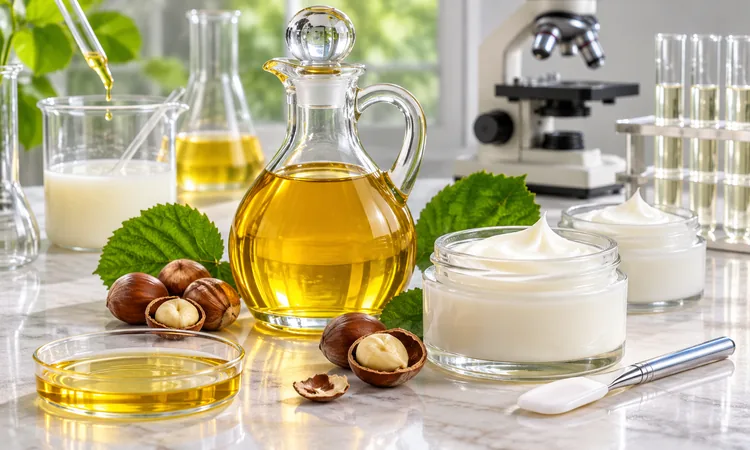
Overview. Topical cream bases are complex formulations containing aqueous and lipid components designed to achieve specified physical characteristics and application properties. Refined hazelnut oil may be investigated as a candidate vegetable-derived lipid ingredient in experimental cream base systems. Any proposed pharmaceutical or other regulated use requires independent material qualification, safety assessment and compliance with applicable requirements.
Refined Hazelnut Oil in Experimental Topical Cream Bases
Cream bases typically incorporate an oil phase, an aqueous phase, emulsifying agents and other functional ingredients to produce a stable semisolid formulation.
Refined hazelnut oil contains predominantly unsaturated fatty acids, especially oleic acid, and may be considered during preliminary evaluation of botanical lipid ingredients.
Its contribution to a cream base depends on the complete formulation, including oil concentration, emulsifier selection, processing conditions and interactions with other materials.
Experimental incorporation does not establish that the supplied oil meets pharmaceutical-grade requirements or is suitable for medicinal product manufacturing.
Oil-in-Water and Water-in-Oil Research Systems
Experimental topical cream bases may use different emulsion structures depending on the intended formulation characteristics.
- Oil-in-water (O/W) emulsions: Dispersed lipid droplets are stabilized within a continuous aqueous phase.
- Water-in-oil (W/O) emulsions: Water droplets are dispersed within a continuous lipid phase.
- Multi-lipid cream bases: Different compatible oils or lipid ingredients are combined to investigate physical and rheological behavior.
Refined hazelnut oil may influence the behavior of the oil phase, but formulation performance must be demonstrated under controlled experimental conditions.
Emulsion Compatibility and Physical Properties
Selection of a lipid ingredient can affect the structure and stability of a cream base.
Important formulation considerations include:
- Oil-phase concentration: The amount of refined hazelnut oil incorporated into the experimental base.
- Emulsifier compatibility: Interaction of the selected oil with the emulsifying system.
- Droplet characteristics: Size and distribution of the dispersed phase.
- Rheology: Viscosity, flow behavior and semisolid consistency.
- Physical stability: Resistance to creaming, coalescence or phase separation.
Researchers should compare prototype formulations with a suitable reference base to assess the specific effect of the selected oil.
Manufacturing and Process Development
Laboratory preparation of cream bases may involve controlled heating, separate phase preparation, emulsification, homogenization and cooling.
Relevant process parameters include ingredient addition sequence, temperature exposure, mixing intensity and batch consistency.
Researchers should document the processing conditions used for each experimental formulation and assess their effect on the final product's physical properties.
Any progression toward regulated manufacturing requires applicable quality systems, validated processes and appropriate supplier and material qualification.
Impurity Profiling and Raw-Material Qualification
Vegetable oils considered for regulated products may require more extensive analytical qualification than materials intended only for general industrial use.
Depending on the target application, research teams may need to assess identity, fatty acid composition, impurity profiles, oxidation indicators and microbiological quality.
Relevant documentation requirements may include specifications, available batch test results, manufacturing information and applicable supplier records.
The appropriate acceptance criteria must be determined by the developing organization according to the intended regulated use.
Preservative Effectiveness and Microbiological Control
Water-containing cream bases can present microbiological risks that must be addressed through formulation design, manufacturing hygiene and suitable preservation strategies.
Preservative effectiveness testing and microbial quality assessments may be required depending on the intended product and regulatory framework.
The presence of refined hazelnut oil does not eliminate the need for appropriate microbiological risk assessment.
Packaging Compatibility and Stability Studies
Experimental cream bases should be evaluated for stability under relevant storage conditions.
Important assessments may include:
- Changes in appearance, odor and color.
- Viscosity and texture changes during storage.
- Phase separation and droplet stability.
- Oxidation indicators and chemical compatibility.
- Microbiological quality and preservative performance.
- Container-closure compatibility, including potential migration or interaction with packaging components.
Where the intended product is medicinal, stability and container-closure studies must follow the applicable regulatory and development requirements.
Refined Hazelnut Oil Technical Specifications
Ingredient specification review is an important step in any material screening or formulation feasibility program.
The stated quality parameters of the supplied refined hazelnut oil include:
| Quality Parameter | Stated Value |
|---|---|
| Free Fatty Acids (FFA) | Maximum 0.3% |
| Moisture Content | Maximum 0.2% |
| Oleic Acid | 74.2–86.7% |
These are stated raw-material acceptance values and do not establish pharmacopoeial compliance, pharmaceutical-grade certification or suitability for any specific regulated product.
Additional analytical testing and documentation may be required depending on the intended research or commercial application.
Review the refined hazelnut oil technical specifications and confirm available current documentation before procurement.
Regulatory Qualification and Product Classification
Cream bases used in regulated products may fall under different regulatory frameworks depending on intended use, composition and product claims.
Cosmetic products and medicinal products can have significantly different quality, safety and authorization requirements.
Edible-grade refined hazelnut oil is not automatically an accepted pharmaceutical excipient.
Pharmaceutical applications may require additional material qualification, applicable pharmacopoeial assessment, toxicological evaluation, validated manufacturing controls and regulatory acceptance.
No claim of pharmaceutical-grade approval, clinical efficacy or therapeutic suitability is made for the supplied product.
Safety and Sensitization Considerations
Hazelnut is a tree nut, and potential sensitization risks should be addressed during the appropriate product safety assessment.
The degree of refining does not, by itself, establish that all potential risks have been eliminated.
The developing organization must determine whether the material is appropriate for the intended population, exposure conditions and regulated use.
Bulk Refined Hazelnut Oil for Research Procurement
Atlas Global Trading supplies refined hazelnut oil for international industrial and wholesale customers.
Research teams may request current product information and available documentation for preliminary material screening.
Commercial packaging options include:
- 30 kg plastic drums: A smaller industrial packaging format.
- 60 kg plastic drums: An intermediate commercial supply option.
- 200 kg plastic drums: Suitable for larger-volume ingredient requirements.
- Larger export and tanker formats: Considered according to commercial volume and logistics feasibility.
These packaging arrangements are commercial supply options and do not establish pharmaceutical manufacturing or excipient qualification status.
Buyers should confirm required quantity, grade, packaging, destination, specifications and available supporting documentation before ordering.
Commercial and Technical Purchasing Considerations
Research ingredient procurement should be coordinated with formulation, analytical and quality teams to determine whether the available material is appropriate for the intended preliminary investigation.
Commercial inquiries may address batch traceability, current specifications, available documents, shipment arrangements, receiving conditions and trade terms.
If the target product requires a specifically qualified pharmaceutical excipient, the buyer must establish those requirements independently before procurement.
Why Contact Atlas Global Trading?
Atlas Global Trading focuses on international bulk refined hazelnut oil supply for professional ingredient buyers.
Clear communication regarding the intended research application, required quality documents and packaging preferences supports more efficient commercial evaluation.
Provide your expected order volume, preferred packaging, delivery destination, intended research application and technical documentation requirements. Our team will review the inquiry and discuss available product information. Final material qualification, safety assessment and regulatory compliance remain the responsibility of the developing organization.