
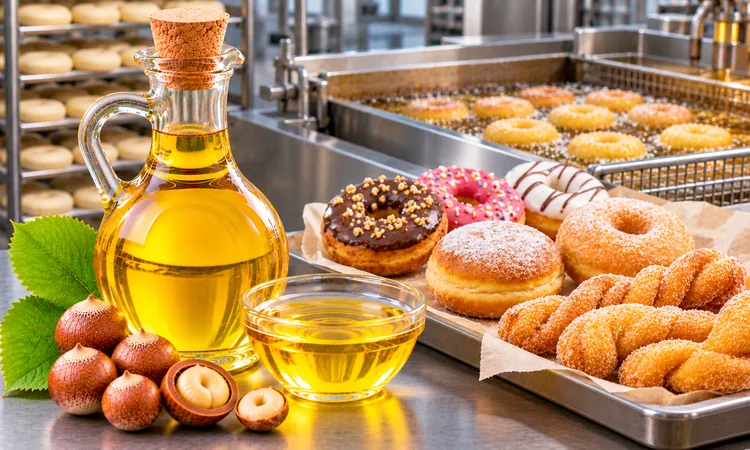
Overview. Industrial doughnuts and fried pastries require controlled fat systems, consistent processing and reliable quality monitoring. Refined hazelnut oil may be evaluated as a liquid ingredient in selected dough formulations or as a candidate oil for carefully controlled frying trials. Its suitability depends on fat functionality, frying conditions, oil degradation and finished-product testing.
Refined Hazelnut Oil in Industrial Doughnut Production
Fat plays different roles in doughnut and pastry manufacturing depending on whether it is incorporated into the dough or used as the frying medium.
Refined hazelnut oil contains predominantly unsaturated fatty acids, particularly oleic acid, and may be evaluated for suitable liquid-fat applications.
The requirements of a dough ingredient differ substantially from those of a frying oil. Manufacturers should evaluate these uses independently under representative processing conditions.
Potential Bakery and Fried Pastry Applications
Industrial bakeries may investigate refined hazelnut oil in selected product systems:
- Yeast-raised doughnut dough: Evaluation of liquid fat inclusion and its influence on dough handling and texture.
- Cake-style doughnuts: Assessment of fat dispersion, batter behavior and finished-product sensory properties.
- Fried pastry formulations: Controlled trials involving compatible fat systems and defined processing conditions.
- Experimental frying applications: Comparative evaluations of oil performance where operating temperatures are appropriate.
Commercial adoption should follow appropriate recipe, equipment and shelf-life validation.
Liquid Fat Versus Solid Bakery Shortening
Refined hazelnut oil is liquid at typical handling temperatures and does not provide the same crystalline structure as solid bakery shortening.
Replacing a structured fat can alter dough development, mixing behavior, lubrication and finished-product texture.
Manufacturers should evaluate the complete formulation rather than assuming a direct one-to-one substitution.
Dough Mixing, Proofing and Texture
Doughnut production depends on flour properties, hydration, mixing, fermentation or proofing conditions and fat distribution.
Changes to the fat system may influence dough handling, consistency and the finished pastry's eating quality.
Controlled trials should evaluate dough development, proofing behavior, expansion during frying and final crumb characteristics.
Frying Temperature and Process Control
Commercial frying involves sustained thermal exposure and interaction between the oil, food moisture and processing environment.
Oil temperature, fryer loading, food moisture release, oil turnover and filtration practices can influence frying performance and degradation.
Refined hazelnut oil should not be assumed suitable for continuous high-temperature frying solely from its fatty acid composition.
Appropriate operating temperatures and oil replacement criteria must be established through application-specific technical assessment.
Oil Absorption and Finished-Product Greasiness
Fried pastries absorb varying amounts of oil depending on recipe composition, frying conditions and cooling behavior.
Dough moisture, crust formation, frying time and post-fry handling can influence oil uptake.
Manufacturers should measure finished-product oil content and evaluate surface greasiness rather than assuming that changing frying oil alone will reduce absorption.
Frying Oil Degradation and Replacement Criteria
Frying oils may undergo oxidation, hydrolysis and polymerization during repeated thermal use.
Monitoring may include total polar compounds, free fatty acids, selected oxidation indicators, color, foaming and sensory quality.
Total polar compounds can provide useful information about accumulated frying oil degradation, but acceptance thresholds depend on applicable regulations and the manufacturer's quality program.
Oil discard decisions should follow validated procedures rather than relying on visual appearance alone.
Filtration, Oil Turnover and Fryer Management
Fryer management can influence the operating life and quality of a frying oil.
Food particles, moisture, residual crumbs and excessive thermal exposure may contribute to deterioration.
Manufacturers should evaluate filtration, cleaning, oil replenishment and replacement procedures under actual production conditions.
Oil topping-up does not eliminate accumulated degradation products.
Finished-Product Texture and Sensory Quality
Doughnuts and fried pastries require suitable crust characteristics, crumb texture, appearance and flavor.
Changing the dough fat or frying oil may influence the sensory profile of the finished product.
Product developers should compare texture, flavor, odor, surface oiliness and storage changes against a reference formulation.
Packaging and Shelf-Life Stability
Fried pastry quality can change after cooling, filling and packaging.
Moisture migration, texture changes, oil migration and oxidation may affect finished-product acceptability.
Shelf-life studies should consider the complete product, including fillings, coatings, packaging and intended storage conditions.
Recommended Industrial Frying and Dough Trials
A controlled development program should use defined reference conditions and document any changes to the oil or fat system.
Relevant tests may include:
- Dough or batter mixing consistency.
- Proofing and expansion behavior.
- Frying temperature and processing time.
- Finished-product oil absorption.
- Crust, crumb and sensory quality.
- Frying oil free fatty acids and total polar compounds.
- Oxidation, color and foaming trends.
- Packaging performance and product shelf life.
Manufacturers should validate safe processing parameters and oil replacement intervals before commercial-scale use.
Refined Hazelnut Oil Technical Specifications
Incoming oil quality is important in ingredient qualification and process development. The stated refined hazelnut oil parameters include:
| Quality Parameter | Stated Value |
|---|---|
| Free Fatty Acids (FFA) | Maximum 0.3% |
| Moisture Content | Maximum 0.2% |
| Oleic Acid | 74.2–86.7% |
These figures are stated raw-material acceptance parameters. They do not establish continuous frying suitability, thermal stability limits or finished-product shelf life.
Additional testing may be required for oxidation stability, thermal performance and incoming batch quality according to the intended use.
Review the refined hazelnut oil technical specifications and confirm current available documentation.
Food Safety and Allergen Management
Hazelnut is a tree nut and must be considered under applicable allergen labeling requirements.
Industrial doughnuts and fried pastries may contain additional allergens such as wheat, milk and eggs depending on the recipe.
Manufacturers should maintain ingredient labeling, sanitation, cross-contact controls, fryer management and suitable food safety procedures.
Shared frying oil may create additional allergen cross-contact concerns that require application-specific assessment.
Bulk Refined Hazelnut Oil for Industrial Bakeries
Atlas Global Trading supplies refined hazelnut oil to international industrial and wholesale ingredient buyers, including bakeries and pastry manufacturers evaluating specialty edible oil applications.
Commercial packaging formats include:
- 30 kg plastic drums: Smaller industrial purchasing quantities.
- 60 kg plastic drums: Intermediate bulk ingredient orders.
- 200 kg plastic drums: Larger-volume industrial bakery procurement.
- Larger export and tanker formats: Subject to commercial volume and logistics feasibility.
Atlas Global Trading supplies refined hazelnut oil as a bulk raw material, not finished doughnuts, pastries or bakery products.
Commercial Procurement and Supply Planning
Professional buyers should identify their intended application, expected consumption, required oil specifications, packaging preference and delivery destination.
Commercial discussions may include current product documentation, batch requirements, storage arrangements, international shipping and applicable trade terms.
Final ingredient qualification and food safety compliance remain the manufacturer's responsibility.
Share your intended doughnut or fried pastry application, expected purchasing quantity, preferred packaging, delivery destination and technical documentation requirements. Our team will review your inquiry and discuss available international bulk supply options.