
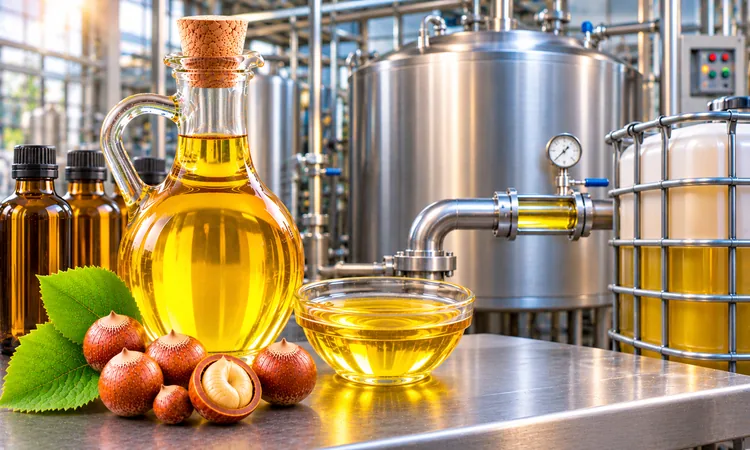
Overview. Light and oxygen exposure can affect the quality of unsaturated vegetable oils throughout industrial handling and storage. Refined hazelnut oil contains predominantly unsaturated fatty acids and benefits from suitable protection against unnecessary oxidation. Closed transfer, appropriate packaging, controlled storage and regular quality testing can support consistent ingredient handling.
Why Oxidation Management Matters for Refined Hazelnut Oil
Oxidation is a chemical process that may alter the sensory and analytical characteristics of edible oils.
Refined hazelnut oil contains unsaturated fatty acids, particularly oleic acid, that may undergo oxidation under unfavorable conditions.
Controlling avoidable exposure helps manufacturers manage oil quality from receipt through transfer, storage, processing and filling.
Appropriate procedures should be based on actual processing conditions rather than assumptions about raw-material stability.
Oxygen Exposure During Bulk Oil Handling
Oxygen may enter an oil-handling system during unloading, pumping, mixing, sampling or filling.
Open transfer, splashing, agitation and air entrainment can increase contact between oil and atmospheric oxygen.
Industrial process design should therefore consider enclosed pipelines, suitable pumping conditions and controlled transfer procedures.
Operators should also verify the cleanliness and integrity of receiving equipment.
Closed Transfer and Reduced Air Entrapment
Closed transfer systems can reduce avoidable contact with ambient air compared with exposed handling.
The effectiveness of a transfer arrangement depends on equipment condition, operating procedures and the prevention of leaks or unintended air introduction.
Manufacturers should consider suitable hoses, pumps, seals and fittings for food-grade edible oil handling.
Transfer design must also accommodate hygienic cleaning and traceability requirements.
Storage-Tank Headspace Management
The space above stored oil, known as tank headspace, may contain atmospheric oxygen.
Changes in tank fill level, temperature and operation can influence gas exchange and oxygen availability.
Suitable headspace management may involve minimizing unnecessary exposure and maintaining appropriate tank closure arrangements.
Inert-gas blanketing, including nitrogen systems, may be considered in properly designed installations where technically and commercially justified.
Such systems require engineering review, suitable gas quality, pressure protection and worker-safety controls.
Light Exposure and Photooxidation
Exposure to light may contribute to the oxidation of edible oils, depending on the oil's composition and the presence of photosensitizing substances.
Direct sunlight and prolonged exposure to strong lighting should be considered during storage and processing.
Opaque or appropriately light-protective containers may reduce exposure, but their suitability must be verified for the intended conditions.
Light protection alone does not eliminate other sources of oil quality deterioration.
Storage Temperature and Thermal Exposure
Temperature can influence the rate of chemical changes in edible oils.
Unnecessary heating and prolonged storage at elevated temperatures may accelerate quality loss.
Manufacturers should establish appropriate storage-temperature limits based on the oil's characteristics, packaging and expected holding period.
If heating is required for an industrial operation, its duration and temperature should be controlled.
Packaging Barriers and Container Integrity
Industrial packaging should provide suitable protection during handling, storage and transportation.
Relevant considerations include oxygen permeability, light transmission, closure integrity and compatibility with refined hazelnut oil.
Not all plastic containers provide the same barrier performance.
Packaging qualification should consider the actual material construction, storage duration and destination-market requirements.
Peroxide Value and Oxidation Monitoring
Peroxide value is commonly used to monitor primary oxidation products in edible oils.
However, peroxide value alone does not fully describe oxidation because primary oxidation products may change or decompose over time.
Additional testing may include suitable secondary oxidation indicators and sensory observations, depending on the quality-control program.
Monitoring trends under consistent analytical conditions is important for meaningful comparisons.
Sampling, Traceability and Storage Studies
Quality assessments should use representative sampling methods and documented analytical procedures.
Exposure to air or light during sample collection and storage may influence test results.
Relevant records may include batch identification, storage duration, temperature history, container type and analytical findings.
Stability studies should reflect realistic commercial storage and distribution conditions.
Recommended Oil Processing Quality Checks
Industrial operators should establish a monitoring plan suitable for their own production systems.
Relevant checks may include:
- Incoming batch identity and quality documentation.
- Peroxide value and suitable secondary oxidation indicators.
- Oil appearance, odor and sensory changes.
- Tank and container closure integrity.
- Storage and transfer temperature records.
- Evidence of air entrainment during pumping.
- Packaging compatibility and light protection.
- Cleaning procedures and traceability.
- Representative storage and shelf-life studies.
Testing frequency and acceptance criteria should be established according to the facility's quality-management requirements.
Refined Hazelnut Oil Technical Specifications
Incoming raw-material quality is an important part of oxidation management. The stated refined hazelnut oil parameters include:
| Quality Parameter | Stated Value |
|---|---|
| Free Fatty Acids (FFA) | Maximum 0.3% |
| Moisture Content | Maximum 0.2% |
| Oleic Acid | 74.2–86.7% |
These are stated raw-material acceptance parameters. They do not guarantee oxidation resistance, shelf life or performance under every processing condition.
Buyers should confirm relevant oxidation parameters and current batch documentation according to their own purchasing specifications.
Review the refined hazelnut oil technical specifications before final procurement.
Food Safety and Allergen Management
Industrial oil-handling systems should be designed for appropriate hygiene, material compatibility and ingredient traceability.
Hazelnut is a tree nut. Facilities should evaluate allergen cross-contact controls and any applicable food-labeling obligations.
Closed transfer and oxidation controls do not replace sanitation, contamination prevention or food safety procedures.
Bulk Refined Hazelnut Oil Packaging and Supply
Atlas Global Trading supplies refined hazelnut oil for international industrial and wholesale ingredient buyers.
Commercial packaging formats include:
- 30 kg plastic drums: Smaller industrial purchasing requirements.
- 60 kg plastic drums: Intermediate bulk supply.
- 200 kg plastic drums: Larger-volume ingredient purchasing.
- Larger export and tanker formats: Subject to order volume and logistics feasibility.
Container materials, barrier properties and available packaging documentation should be confirmed for the actual supply arrangement.
Commercial Procurement and Supply Planning
Buyers should identify their expected consumption, packaging preference, storage arrangements, receiving facilities and delivery destination.
Commercial discussions may include current product specifications, available batch documentation, shipment planning, storage requirements and relevant trade terms.
Importers and manufacturers should establish handling conditions appropriate to their process and intended storage period.
Provide your expected purchasing quantity, preferred packaging, delivery destination, storage arrangements and technical documentation requirements. Our team will review your inquiry and discuss available bulk supply options.