
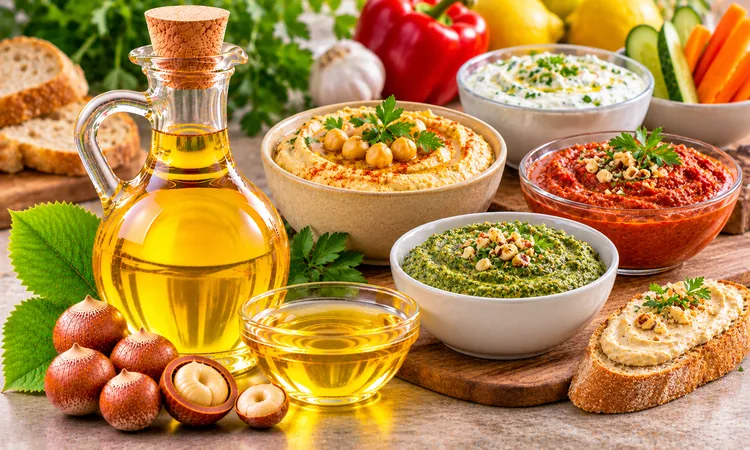
Overview. Dips, spreads and savory pastes are prepared food systems in which the oil phase plays an important role in texture, lubrication, mouthfeel and product stability. Refined hazelnut oil may be evaluated as a liquid vegetable oil ingredient in selected savory formulations where controlled oil incorporation and consistent raw-material quality are required.
The Role of Refined Hazelnut Oil in Savory Food Formulations
Savory prepared foods commonly combine vegetable oils with ingredients such as water, vegetables, legumes, nuts, seeds, proteins, seasonings and stabilizing components.
The oil phase contributes to lubrication and can influence the perceived smoothness, richness and spreading characteristics of the finished product.
Refined hazelnut oil has a predominantly unsaturated fatty acid composition and may be investigated as an alternative or supplementary lipid ingredient in selected industrial formulations.
The final sensory and physical result depends on the complete recipe, processing conditions and storage environment.
Potential Applications in Dips, Spreads and Pastes
Refined hazelnut oil may be assessed for use in several categories of savory prepared foods, provided the formulation and market requirements are satisfied.
- Vegetable-based spreads: Incorporation into selected vegetable or legume blends to adjust lubrication and consistency.
- Savory dipping sauces: Evaluation as part of the oil phase in emulsified or blended sauce formulations.
- Seed and nut-based pastes: Controlled oil addition where the formulation requires adjustment of spreading or mixing characteristics.
- Seasoned savory preparations: Use in selected oil-containing ingredient systems requiring a defined texture and sensory profile.
Formulators should evaluate whether refined hazelnut oil provides the intended functional and sensory characteristics without negatively affecting product stability.
Oil Phase, Texture and Spreadability
The oil phase affects the mechanical and sensory behavior of dips and spreads.
The amount and type of oil influence lubrication and interactions between dispersed food particles. These effects can change viscosity, spreadability and mouthfeel.
Important formulation variables include:
- Oil concentration: The proportion of liquid fat relative to the remaining ingredients.
- Particle size: The degree of milling or homogenization applied to solid food ingredients.
- Water content: The contribution of the aqueous phase to texture and preservation needs.
- Emulsifiers and stabilizers: Their ability to maintain a suitable product structure.
- Temperature: Its influence on processing viscosity and finished-product consistency.
A formulation containing refined hazelnut oil should be compared against a reference recipe under controlled processing conditions.
Emulsion Stability and Oil Separation
Depending on composition, savory dips and spreads may behave as emulsions, particle suspensions or complex multiphase food systems.
An important quality consideration is the tendency of oil or water to separate during storage.
Oil pooling, creaming and syneresis can influence product appearance, consistency and consumer acceptance.
Manufacturers should assess the interactions between oil content, particle size, protein functionality, emulsifier selection and processing intensity.
Where separation is a critical quality attribute, acceptable limits should be established and verified through stability testing in the final packaging.
Industrial Processing and Production Control
Industrial manufacturing methods vary according to the intended product, but may involve ingredient preparation, controlled oil addition, grinding, mixing, emulsification and filling.
Processing variables that can influence the finished product include:
- Ingredient addition sequence and mixing duration.
- Oil dosing accuracy and batch consistency.
- Milling or homogenization intensity.
- Processing temperature and exposure time.
- Equipment cleanliness and allergen cross-contact control.
- Filling conditions and packaging integrity.
Controlled pilot batches should be used to evaluate changes in texture, appearance, flavor and storage stability before commercial production.
Food Safety and Shelf-Life Evaluation
Finished-product safety depends on the complete formulation, manufacturing process and intended storage conditions.
Moisture content, water activity, acidity, salt concentration and processing controls may all influence microbiological stability.
Relevant product evaluations may include:
- pH and water activity, where applicable.
- Microbiological testing and validation of the intended food safety control measures.
- Oil separation, syneresis and physical stability.
- Viscosity, spreadability and particle size distribution.
- Color, odor, flavor and sensory consistency.
- Oxidation indicators and storage behavior.
- Packaging compatibility and performance throughout shelf life.
The use of refined hazelnut oil does not itself establish microbiological safety, ambient shelf stability or a defined product shelf life.
Refined Hazelnut Oil Technical Specifications
Ingredient quality should be evaluated as part of the manufacturer's raw-material approval process.
The stated refined hazelnut oil specifications include:
| Quality Parameter | Stated Value |
|---|---|
| Free Fatty Acids (FFA) | Maximum 0.3% |
| Moisture Content | Maximum 0.2% |
| Oleic Acid | 74.2–86.7% |
These values describe the stated raw-material acceptance parameters and do not guarantee a particular texture, storage stability or functional outcome in a finished food.
Additional incoming quality checks may be required according to the application. Consult the refined hazelnut oil technical specifications and confirm batch-specific documentation.
Recommended Formulation Trials
Manufacturers considering refined hazelnut oil for dips and spreads should begin with a defined reference formulation.
Trials may compare different oil concentrations and mixing conditions, followed by evaluation of product texture, sensory characteristics, separation behavior and stability.
Finished products should be assessed immediately after production and after storage under representative distribution and consumption conditions.
Bulk Refined Hazelnut Oil for Food Manufacturers
Atlas Global Trading supplies refined hazelnut oil for international industrial and wholesale customers, including prepared food manufacturers evaluating specialty oil ingredients.
Available packaging options include:
- 30 kg plastic drums: A smaller industrial packaging format.
- 60 kg plastic drums: An intermediate commercial supply option.
- 200 kg plastic drums: Suitable for larger-volume manufacturing requirements.
- Larger export and tanker formats: Considered according to order volume and logistics feasibility.
Buyers should confirm the intended application, purchase quantity, packaging preference, destination country and required quality documentation before ordering.
Commercial discussions may also address shipping conditions, batch traceability, product specifications, delivery schedules and relevant trade terms.
Allergen Management and Regulatory Requirements
Hazelnut is a tree nut and is subject to allergen labeling requirements in many food markets.
Manufacturers should review ingredient declarations, cross-contact prevention procedures and finished-product labeling according to the requirements of their target markets.
Food safety and regulatory suitability must be evaluated for the complete finished product. The use of an edible refined oil does not eliminate these obligations.
Why Source from Atlas Global Trading?
Atlas Global Trading focuses on the international supply of refined hazelnut oil for industrial and wholesale ingredient buyers.
Our commercial approach emphasizes clear product information, practical bulk packaging alternatives and purchasing discussions based on customer requirements.
Share your planned order volume, packaging preference, delivery destination and technical requirements. Our team will review the inquiry and discuss available commercial options. Final formulation suitability, food safety and regulatory compliance remain the manufacturer's responsibility.