
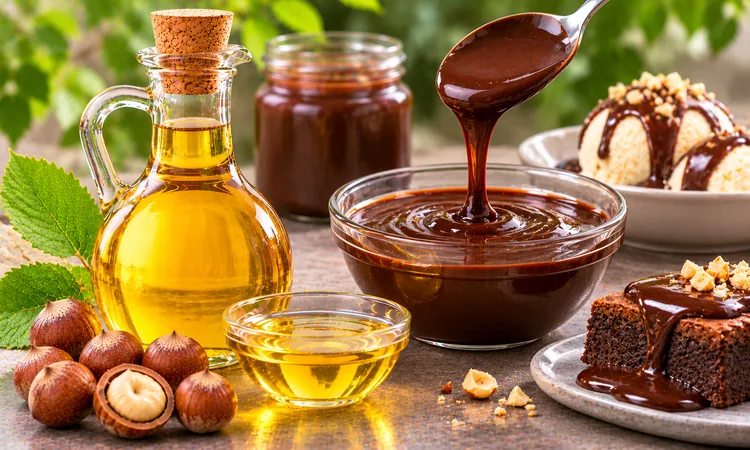
Technical and Commercial Overview
Refined hazelnut oil may be evaluated as part of the liquid fat phase in selected chocolate dessert sauces, confectionery toppings and cocoa-based dessert formulations.
Its potential role depends on the desired product structure, viscosity, pourability, flavor, fat composition and storage behavior.
Unlike a finished chocolate bar, many dessert sauces are designed to remain pourable or pumpable over their intended serving and processing temperature range.
Chocolate dessert sauces can use different formulation systems, including oil-continuous suspensions, water-based cocoa sauces and emulsified products.
These systems have different technical requirements. An oil suitable for one formulation cannot automatically be substituted into another without testing.
This guide examines the role refined hazelnut oil may play, the key production and quality risks, and the commercial information required for bulk ingredient purchasing.
1. Applications in Chocolate Dessert Sauces and Toppings
Chocolate dessert sauces are used in a range of industrial and foodservice applications.
Formulations may be developed for pouring, dipping, drizzling, coating or other suitable uses. The required viscosity, appearance and stability vary by application.
Pourable Chocolate Sauces
Liquid fat selection may influence the sauce's flow behavior, texture and performance at specified serving temperatures.
Chocolate Dessert Toppings
Manufacturers may assess refined hazelnut oil within formulations intended for ice cream, bakery desserts or prepared sweet foods.
Foodservice Sauces
Industrial foodservice products may require consistent dispensing, storage stability and appropriate packaging performance.
Cocoa-Based Dessert Preparations
Refined hazelnut oil may be evaluated within suitable cocoa-containing formulations where liquid fat functionality is required.
Function of the Oil Phase
The fat phase can influence lubrication between suspended particles, mouthfeel, appearance and the product's flow properties.
In an oil-continuous suspension, the liquid fat is part of the medium surrounding cocoa, sugar and other solid particles.
In a water-based or emulsified sauce, the oil has a different structural role, and formulation performance depends on the complete emulsion system.
Flavor and Sensory Positioning
Refined hazelnut oil should not be assumed to provide the same characteristic flavor as roasted hazelnuts or hazelnut paste.
Refining may reduce characteristic nutty sensory notes, and the final flavor contribution must be assessed in the specific chocolate sauce.
2. Refined Hazelnut Oil Technical Specifications
Ingredient specifications are important when evaluating refined hazelnut oil for commercial dessert sauce manufacturing.
Fatty-acid composition, oxidation condition and physical properties may influence both raw material qualification and formulation development.
| Parameter | Specification | Application relevance |
|---|---|---|
| Composition | 100% refined hazelnut oil | Raw material identity. |
| Oleic acid | 74.2–86.7% | Dominant monounsaturated fatty acid. |
| Linoleic acid | 5.2–18.7% | Polyunsaturated fatty-acid fraction. |
| Palmitic acid | 4.2–8.9% | Saturated fatty-acid component. |
| Stearic acid | 0.8–3.2% | Additional saturated fatty-acid component. |
| Free fatty acids | Maximum 0.3% | Relevant to oil condition and refining quality. |
| Moisture | Maximum 0.2% | Relevant to ingredient storage and handling. |
| Peroxide value | Maximum 10 meq/kg | Primary oxidation indicator. |
| Density at 20°C | 0.898–0.915 | Physical identity and mass-volume assessment. |
| Iodine value | 81–92 | Degree of fatty-acid unsaturation. |
| Saponification value | 188–198 mg KOH/g | Additional oil characterization. |
| Refractive index at 20°C | 1.468–1.473 | Physical identity assessment. |
| Insoluble impurities | Maximum 0.05% (m/m) | Ingredient cleanliness assessment. |
High-Oleic Fatty-Acid Profile
Oleic acid represents the dominant fatty-acid fraction in refined hazelnut oil.
This composition may be relevant to oxidation behavior and the characteristics of the liquid fat phase, but it does not independently establish product stability or a required viscosity.
Peroxide Value and Oil Quality
Peroxide value is a measure of primary oxidation products. The published maximum is 10 meq/kg.
Manufacturers may establish tighter incoming limits depending on their finished-product specifications and expected storage conditions.
3. Chocolate Dessert Sauce Formulation Systems
Chocolate dessert sauces are not a single standardized formulation category. Different products can rely on substantially different physical structures.
Before considering refined hazelnut oil, manufacturers should establish the formulation type and desired finished characteristics.
Oil-Continuous Cocoa Suspensions
Some sauces use a continuous fat phase containing dispersed cocoa, sugar and other solid particles. Particle suspension and fat compatibility are major considerations.
Water-Based Cocoa Sauces
Water, sugars, cocoa and suitable thickening ingredients may form the base of a pourable dessert sauce. Added oil requires appropriate dispersion or emulsification.
Emulsified Dessert Sauces
Oil and aqueous components may be combined through suitable emulsifiers and processing methods. Stability must be evaluated under intended storage conditions.
Structured Chocolate Toppings
Certain toppings are designed to thicken or develop structure under selected temperature conditions. Their behavior depends on the complete fat and solids system.
Interaction with Cocoa Solids
Cocoa powder contributes particles that must be dispersed uniformly throughout the formulation.
Poor dispersion can cause visible agglomerates, uneven texture or sedimentation.
Particle size, solids loading, mixing conditions and the continuous phase all affect the final product.
Interaction with Sugar
Sugar behaves differently in water-based and fat-continuous systems.
In aqueous sauces, sugar can dissolve within the available water phase.
In low-moisture fat-continuous systems, sugar particles may remain dispersed solids.
The manufacturer must determine the intended physical state of each ingredient and process the product accordingly.
Liquid Fat Incorporation
Refined hazelnut oil may be evaluated as one component of the fat phase.
Increasing or replacing liquid fat can change the relationship between the continuous phase, suspended solids and other structuring ingredients.
Consequently, a formulation change should be assessed through controlled pilot trials, not assumed to be a direct one-to-one substitution.
4. Viscosity, Pourability and Chocolate Sauce Rheology
Sauce rheology determines how a product behaves during mixing, pumping, filling, dispensing and consumption.
Viscosity is not solely controlled by the oil's viscosity. Solids concentration, particle characteristics, emulsifiers, temperature and processing conditions can all influence the result.
Apparent Viscosity
Many concentrated food dispersions exhibit non-Newtonian flow behavior, meaning their apparent viscosity can vary with shear conditions.
Manufacturers should measure viscosity using defined methods, temperatures and shear conditions relevant to the intended process.
Yield Stress
Some structured or concentrated sauces require a minimum applied stress before they begin flowing.
This characteristic may help limit particle settling, but excessive yield stress can make pumping and dispensing more difficult.
Pourability and Dispensing
The desired flow properties vary between a squeeze-bottle topping, a pumpable industrial sauce and a controlled drizzle application.
Product developers should define performance criteria at the actual intended serving and storage temperatures.
Suggested Rheology Evaluation
- Viscosity at defined temperatures and shear conditions.
- Flow initiation and yield behavior where relevant.
- Pouring, pumping and nozzle dispensing performance.
- Changes after storage and temperature cycling.
- Effect of cocoa solids and fat-phase adjustments.
- Texture and sensory consistency.
5. Cocoa Dispersion, Sedimentation and Oil Separation
Maintaining a uniform chocolate sauce may require adequate dispersion and suspension of cocoa and other particles.
Insufficient process control or an unsuitable formulation can result in visible settling, floating oil or changes in texture during storage.
Cocoa Sedimentation
Insoluble cocoa particles may settle if the formulation lacks sufficient suspension stability. Particle dimensions and the product's flow behavior can influence settling.
Oil Separation
The liquid fat phase may separate when the physical structure or emulsification system does not adequately retain or disperse the oil.
Particle Agglomeration
Poor wetting or mixing may produce clusters of cocoa or other ingredients, creating visible defects or inconsistent texture.
Appearance and Sheen
Surface appearance depends on the fat phase, solids, formulation structure and processing. A uniform glossy finish is not guaranteed by adding liquid oil.
Particle Size and Suspension
The size and distribution of particles may affect mouthfeel, dispersion and sedimentation behavior.
Reducing particle size may change rheology, but does not automatically guarantee a stable product.
Temperature and Separation
The fat phase and other ingredients may respond differently to heating and cooling.
Temperature cycling can reveal separation problems that are not visible immediately after production.
6. Fat Compatibility, Crystallization and Chocolate Structure
Chocolate-flavored sauces may contain cocoa butter, other vegetable fats or additional fat-bearing ingredients.
The behavior of the complete fat system influences the physical properties of the finished product.
Cocoa Butter Compatibility
Cocoa butter has a characteristic triglyceride composition and crystallization behavior that differs from liquid refined hazelnut oil.
Replacing cocoa butter or another structured fat with liquid oil can change hardness, melting behavior and product structure.
Manufacturers should not assume refined hazelnut oil can replace cocoa butter in every chocolate product.
Fat Crystallization
Structured fat systems may change during cooling and storage as particular fat components crystallize or reorganize.
Such changes can influence appearance, firmness, oil migration and other physical characteristics.
Bloom and Surface Defects
Certain cocoa-butter-containing systems can develop fat-related surface defects under unsuitable processing or storage conditions.
These phenomena should be investigated in the actual product rather than attributed to one ingredient without appropriate testing.
Chocolate Product Classification
A chocolate dessert sauce and a standardized chocolate product may be subject to different compositional or labeling requirements.
Using non-cocoa vegetable oil may affect the lawful product description in some markets.
Manufacturers should verify applicable food standards and labeling requirements before commercial release.
7. Industrial Chocolate Dessert Sauce Manufacturing
Industrial production requires consistent ingredient weighing, dispersion, mixing, thermal control and filling.
The appropriate processing method depends on the formulation type and the specified finished-product characteristics.
Illustrative Production Development Sequence
- Qualify incoming ingredients. Review refined hazelnut oil, cocoa, sugars and other materials against the approved specifications.
- Define the formulation system. Determine whether the sauce is oil-continuous, aqueous or emulsified.
- Establish ingredient addition. Develop a suitable procedure for dispersing powders and incorporating the fat phase.
- Control mixing and dispersion. Evaluate the equipment and energy required for adequate ingredient distribution.
- Control temperature. Establish processing conditions appropriate to the formula and relevant food safety requirements.
- Measure physical properties. Assess viscosity, pourability, appearance and dispersion.
- Evaluate safety and stability. Conduct relevant microbiological, chemical and physical testing.
- Validate filling and packaging. Confirm dispensing, sealing and compatibility.
- Complete production-scale trials. Verify consistency before approving commercial manufacture.
Mixing and Dispersion Equipment
Depending on the formulation, manufacturers may assess suitable mixers, dispersion equipment or homogenization systems.
The required process depends on solids loading, particle characteristics, viscosity and emulsion requirements.
Temperature Management
Temperature influences the behavior of fats, the viscosity of the sauce and the processing of other ingredients.
Unnecessary heat exposure should be assessed for its potential impact on ingredient and finished-product quality.
Transfer and Filling
Industrial sauce filling equipment should be selected for the actual product viscosity, temperature and hygiene needs.
Pump selection, pipelines, valves and filling nozzles may require trials with the finished formulation.
8. Food Safety, Water Activity and Allergen Management
Chocolate dessert sauces can vary significantly in water content, ingredient composition and processing method.
Accordingly, the appropriate food safety controls depend on the specific finished product.
Moisture and Water Activity
Water-containing dessert sauces may require a different microbiological control strategy from low-moisture fat-continuous formulations.
Product moisture and water activity are related but distinct characteristics and should not be used interchangeably.
Manufacturers should establish the relevant safety parameters for their finished formula.
Microbiological Safety
Cocoa, dairy ingredients, water and other raw materials may present different hazards.
The processing and packaging system should be evaluated under a suitable food safety management program.
Product shelf stability should not be assumed without relevant validation and controls.
Hazelnut Allergens
Hazelnuts are recognized tree-nut allergens in many food markets.
Refining may influence residual protein content, but refined hazelnut oil should not automatically be described as allergen-free.
Manufacturers must assess the ingredient and applicable allergen labeling obligations in the destination market.
Other Common Dessert Sauce Allergens
Depending on the formulation, chocolate dessert sauces may also contain milk, soy or other allergenic ingredients.
The finished-product allergen declaration must reflect the actual recipe, processing controls and applicable regulations.
9. Oxidation, Storage Stability and Shelf-Life Testing
Industrial dessert sauces may experience changes in texture, appearance, flavor or physical structure during storage.
Stability evaluation should account for both the oil ingredient and the finished formulation.
Oxidative Stability
Unsaturated vegetable oils can undergo oxidation in the presence of oxygen and under certain storage conditions.
Light, heat and other formulation constituents may influence oxidation behavior.
Manufacturers may evaluate peroxide value, other appropriate oxidation indicators and sensory changes.
Physical Stability
Relevant observations include cocoa sedimentation, oil separation, viscosity variation, changes in sheen and structural changes.
The importance of each parameter depends on the intended product.
Temperature Cycling
Testing only at normal room temperature may fail to reveal problems that occur during transportation or temperature fluctuations.
Controlled temperature cycling can support evaluation of physical stability and packaging behavior.
Packaging Compatibility
Dessert sauce packaging should be suitable for the actual formulation and intended filling process.
Compatibility may involve the container material, closure, oxygen exposure, dispensing performance and product-contact requirements.
Raw Material Versus Finished-Product Shelf Life
The supplied refined hazelnut oil description states a 24-month shelf life under its recommended storage conditions.
This does not establish a 24-month shelf life for a chocolate dessert sauce containing the ingredient.
Finished-product shelf life must be established through appropriate safety, quality and storage validation.
10. Quality Control and Pilot Production Testing
Manufacturers should define appropriate acceptance criteria for both incoming refined hazelnut oil and the finished chocolate sauce.
A controlled trial program allows the effect of changing the fat phase to be evaluated separately from process variation.
| Evaluation | Purpose | Relevant observation |
|---|---|---|
| Oil identity | Verify the refined hazelnut oil raw material. | Specification and lot documentation. |
| Oil oxidation | Assess incoming oil quality. | Peroxide value and other relevant indicators. |
| Cocoa dispersion | Evaluate mixing and particle distribution. | Agglomeration and uniformity. |
| Particle sedimentation | Evaluate suspension stability. | Settling under defined storage conditions. |
| Viscosity | Evaluate flow behavior. | Measurements at defined temperatures and shear conditions. |
| Pourability | Check intended dispensing performance. | Flow and dispensing observations. |
| Oil separation | Assess fat-phase stability. | Visible oil release or phase separation. |
| Appearance | Assess product presentation. | Color, sheen and surface consistency. |
| Sensory evaluation | Assess consumer-related quality. | Flavor, aroma, texture and mouthfeel. |
| Thermal cycling | Evaluate response to temperature variation. | Changes in separation, flow and structure. |
| Food safety testing | Support finished-product safety validation. | Appropriate microbiological and other controls. |
| Packaging compatibility | Evaluate container suitability. | Seal integrity, leakage and dispensing. |
| Shelf-life assessment | Establish product stability. | Results from validated storage studies. |
Batch-to-Batch Consistency
Commercial production should establish a repeatable process and appropriate finished-product specifications.
Incoming oil quality, cocoa solids and manufacturing conditions should be controlled according to the producer's quality system.
Comparative Pilot Trials
When assessing refined hazelnut oil as a replacement for another fat component, pilot trials should document the original formula, revised formula and process parameters.
A meaningful comparison should use consistent test methods and appropriate storage conditions.
11. Bulk Refined Hazelnut Oil for Chocolate Dessert Sauce Manufacturers
Atlas Global Trading focuses on international bulk and wholesale inquiries for 100% refined hazelnut oil.
Manufacturers evaluating the ingredient for chocolate dessert sauces should specify the intended application and technical acceptance criteria.
Industrial Packaging Options
| Packaging | Published quantity | Purchasing consideration |
|---|---|---|
| Plastic drum | 30 kg net | Smaller industrial bulk handling units. |
| Plastic drum | 60 kg net | Intermediate manufacturing quantities. |
| Plastic drum | 200 kg net | Larger manufacturing consumption with suitable handling equipment. |
| Export flexitank | Shipment-dependent | Containerized bulk liquid supply, subject to route and equipment suitability. |
| Bulk road tanker | 20 tonnes and above | High-volume deliveries requiring appropriate receiving infrastructure. |
Choosing the Packaging Format
Drum-packed refined hazelnut oil may be suitable when separate handling units and flexible inventory management are preferred.
Flexitank and road tanker shipments may be considered for larger consumption volumes where suitable receiving, transfer and storage facilities exist.
The selected format can affect freight costs, unloading, warehouse requirements and overall supply economics.
Supplier Documentation
Industrial buyers may request a current product specification, available lot-specific certificate of analysis, fatty-acid composition and relevant quality information.
Additional test reports or documentation should be specified during the quotation process.
International Delivery
Overseas buyers should identify their destination country, port or delivery location and any special customs or product documentation requirements.
Shipping terms, freight, availability and delivery schedules require individual confirmation.
Information to Include in a Wholesale Inquiry
- Product: 100% refined hazelnut oil.
- Intended use: chocolate dessert sauce or topping manufacturing.
- Required net volume in kilograms or metric tonnes.
- Preferred packaging format.
- Destination country and delivery location.
- Technical acceptance criteria and special requirements.
- Requested certificates or analytical documentation.
- Expected order and shipment period.
- Receiving and storage requirements.
- Whether demand is one-time or recurring.
Explore the bulk packaging options and international export and logistics guidance for more information.
12. Key Technical Considerations
- Refined hazelnut oil may be considered as a liquid fat-phase ingredient in selected chocolate dessert sauces.
- Chocolate sauces can be oil-continuous, aqueous or emulsified, requiring different formulation approaches.
- Viscosity and pourability depend on the entire formulation and its processing conditions.
- Cocoa dispersion, particle sedimentation and oil separation require appropriate evaluation.
- Liquid oil cannot automatically replace structured cocoa butter in every chocolate product.
- Oxidation, temperature cycling and packaging compatibility should be assessed.
- Food safety and allergen obligations must be evaluated for the finished formulation.
- The raw oil's declared shelf life does not establish finished dessert sauce shelf life.
- Bulk purchasing requires confirmation of specifications, quantity, packaging and commercial delivery terms.
Request Refined Hazelnut Oil for Chocolate Dessert Sauce Production
Developing chocolate dessert sauces, toppings or suitable cocoa-based formulations? Contact Atlas Global Trading with your required volume, packaging preference, destination and technical specifications to discuss wholesale supply.
Contact Our Sales TeamRelated Industrial Application Articles
This article provides general technical and commercial guidance. It is not a validated food formulation, a guarantee of manufacturing performance or a replacement for product-specific food safety and regulatory review. Buyers must confirm the actual oil specification, intended-use suitability, technical documentation and applicable requirements before purchase.