
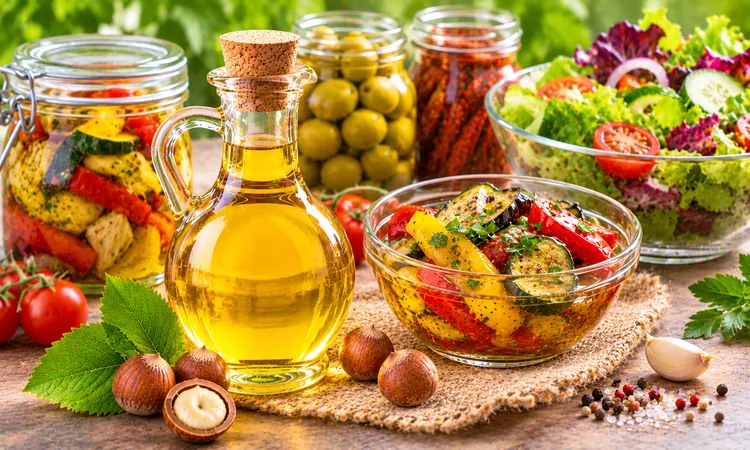
Overview. Vegetable marinades and prepared salads often combine edible oils with vegetables, seasonings, acidic ingredients and other formulation components. Refined hazelnut oil may be evaluated as a liquid oil ingredient in selected products. The complete formulation must provide suitable mixing performance, sensory quality, food safety and stability throughout commercial distribution.
Refined Hazelnut Oil in Vegetable Marinade Formulations
Vegetable marinades may include a liquid oil phase used to distribute seasonings and influence surface coating.
Refined hazelnut oil contains predominantly unsaturated fatty acids, particularly oleic acid, and may be considered for the edible lipid phase in suitable vegetable marinade and prepared salad systems.
Its inclusion should be evaluated against the complete recipe, especially where acids, vegetables and seasonings affect product behavior.
Potential Vegetable Marinade and Salad Applications
Prepared-food manufacturers may evaluate refined hazelnut oil in selected products:
- Marinated vegetable mixes: Investigation of oil coating and seasoning distribution.
- Ready-to-eat prepared salads: Evaluation of oil-phase composition and sensory characteristics.
- Oil-and-acid vegetable marinades: Assessment of mixing, distribution and physical stability.
- Foodservice salad preparations: Testing product consistency, packaging and storage performance.
Each product category may have different preservation, labeling and regulatory requirements.
Oil-Phase Balance and Vegetable Coating
The quantity and composition of the oil phase can influence the distribution of marinades over vegetable surfaces.
Too little oil may limit coating uniformity, while excessive oil can cause unwanted pooling or changes in mouthfeel.
Manufacturers should establish a suitable oil dosage for the actual vegetable mix, cut size and finished-product requirements.
Mixing, Blending and Ingredient Distribution
Industrial prepared-food production may involve batch mixing, tumbling, dosing or controlled blending.
Mixing time, equipment configuration and ingredient addition sequence can influence the uniformity of the final product.
Where oil and aqueous ingredients are combined, phase separation may occur unless the system is appropriately designed.
Manufacturers should document mixing conditions and evaluate the distribution of oil, acid and seasonings.
Acidity, pH and Preservation Requirements
Some vegetable marinades incorporate acidic ingredients to provide flavor and support an appropriate food preservation system.
However, preservation depends on the complete formulation, processing method, vegetable characteristics and storage conditions.
Adding refined hazelnut oil does not independently acidify or preserve prepared vegetables.
Where acidification is used, manufacturers should assess the relevant pH throughout the product and validate the required safety controls.
Microbiological Safety of Prepared Vegetables
Ready-to-eat vegetable products require suitable controls for raw-material hygiene, contamination prevention, processing and storage.
Oil-based marinades do not eliminate microbiological hazards simply by covering vegetable surfaces.
Manufacturers should implement a validated food safety program appropriate to the product, including any relevant refrigeration, acidification, heat treatment or other preservation measures.
Finished-product testing and shelf-life validation should reflect realistic distribution conditions.
Oxidation Stability and Sensory Quality
Refined hazelnut oil contains unsaturated fatty acids, which may oxidize under unfavorable conditions.
Oil quality, other ingredients, oxygen exposure, temperature and packaging may affect the final product's sensory stability.
Relevant assessments may include peroxide value, other oxidation indicators, flavor changes, odor and appearance.
These evaluations should be conducted on the finished prepared-food system where appropriate.
Packaging, Leakage and Storage Stability
Prepared vegetable products may be packed in suitable foodservice containers, sealed tubs or other appropriate retail packaging.
Oil-containing formulations require evaluation of closure integrity, leakage resistance and packaging compatibility.
Manufacturers should also assess separation, vegetable texture, appearance and sensory stability during the intended storage period.
Packaging alone does not establish microbiological safety or guarantee shelf-life performance.
Recommended Vegetable Marinade Production Tests
Product developers should compare controlled experimental formulations with an established reference product.
Relevant tests may include:
- Oil dosage and vegetable coating uniformity.
- Mixing consistency and phase separation.
- pH and acidity distribution where applicable.
- Microbiological safety and preservation validation.
- Vegetable texture and sensory acceptability.
- Oxidation indicators and flavor stability.
- Package leakage and container compatibility.
- Finished-product shelf-life testing.
Commercial production trials should confirm consistent results under intended manufacturing conditions.
Refined Hazelnut Oil Technical Specifications
Incoming raw-material quality supports controlled prepared-food manufacturing. The stated refined hazelnut oil parameters include:
- Free fatty acids (FFA): Maximum 0.3%.
- Moisture content: Maximum 0.2%.
- Oleic acid: 74.2–86.7%.
These values describe stated raw-material acceptance parameters and do not establish preservation, microbiological safety or finished-product shelf life.
Buyers may require additional testing and documentation according to their purchasing specifications and food safety programs.
Review the refined hazelnut oil technical specifications and confirm current available batch documentation.
Food Allergen and Ingredient Labeling
Hazelnut is a tree nut and should be considered under applicable allergen labeling requirements.
Vegetable marinades may contain other allergens from mustard, soy or seasoning ingredients, depending on the formula.
Manufacturers should maintain suitable ingredient traceability, cross-contact prevention and labeling procedures.
Bulk Refined Hazelnut Oil for Prepared-Food Manufacturers
Atlas Global Trading supplies refined hazelnut oil to international industrial and wholesale ingredient buyers, including manufacturers evaluating edible oils for vegetable marinades and prepared salads.
Commercial packaging formats include:
- 30 kg plastic drums: Smaller industrial purchasing quantities.
- 60 kg plastic drums: Intermediate bulk ingredient orders.
- 200 kg plastic drums: Larger-volume prepared-food procurement.
- Larger export and tanker formats: Subject to commercial volume and logistics feasibility.
Atlas Global Trading supplies refined hazelnut oil as a bulk raw material, not finished vegetable marinades or ready-to-eat prepared salads.
Commercial Procurement and Supply Planning
Professional buyers should confirm their intended product application, purchasing quantity, required material grade, packaging preference and delivery destination.
Commercial discussions may include current specifications, available batch documentation, packaging, storage conditions, shipment arrangements and applicable trade terms.
The finished-food manufacturer remains responsible for product safety, preservation validation, labeling and regulatory compliance.
Share your intended vegetable marinade or prepared salad application, expected purchasing volume, preferred packaging, delivery destination and technical documentation requirements. Our team will review your inquiry and discuss available international bulk supply options.